Wondecla Woodland in Autumn

Driving only 10 minutes west from our property in tall eucalypt forest takes you into a completely different habitat: open woodland, which is much more open, the trees are smaller (and, of course, different species) and the undergrowth is sparse, as it is much drier here.

gumbark_1

There were many mistletoes in flower, attracting different species of honeyeaters, like this Yellow-faced Honeyeater.

yellow-faced honeyeater_1

Also rich in nectar are Grevilleas

grevillea_1

and Melaleucas (Paperbarks)

paperbark_1

One of my favourite flowers was in bloom, too: a Fringed Lily

fringed lily_1

Insects were still numerous, making the best of the sunny and warm autumn days.

These sawfly larvae are not caterpillars, but a type of primitive wasp. They were crossing the road, huddled together in the shape of a leaf. They frequently stopped, and started moving again as soon as the frontrunners started tapping their “tails’:


Atherton Tablelands Birdwatchers’ Cabin

We are still busy,  moving to our new property south of Atherton, but here is a first impression of our birdlife there.  Erica and Mike, keen birders from the US, stayed with us in December, and took this footage:

It was very dry then, but since the beginning of the year, we’ve had more than 600mm of long-awaited rain. It brought out many frogs, including these Orange-thighed Treefrogs (Litoria xanthomera):

one male calling:

one-frog-calling1

and it didn’t take long at all:

success!

success-1g

more about Hypsies

We do enjoy  watching the Musky Rat-kangaroos  (Hypsiprimnodon moschatus) in our garden, and sometimes we tease them with a very tempting morsel:

Musky Rat-kangaroos are mainly fruit-eaters (although they were quite keen on a dead White-tailed Rat, and one musky actually managed to drag the cadaver off into the forest), and they absolutely love avocado.

The seed is big and slippery, of course, so they cannot grab it with their teeth. No matter, from which side it tries to grab the seed, it just cannot get a hold of it:

Rainforest Babies

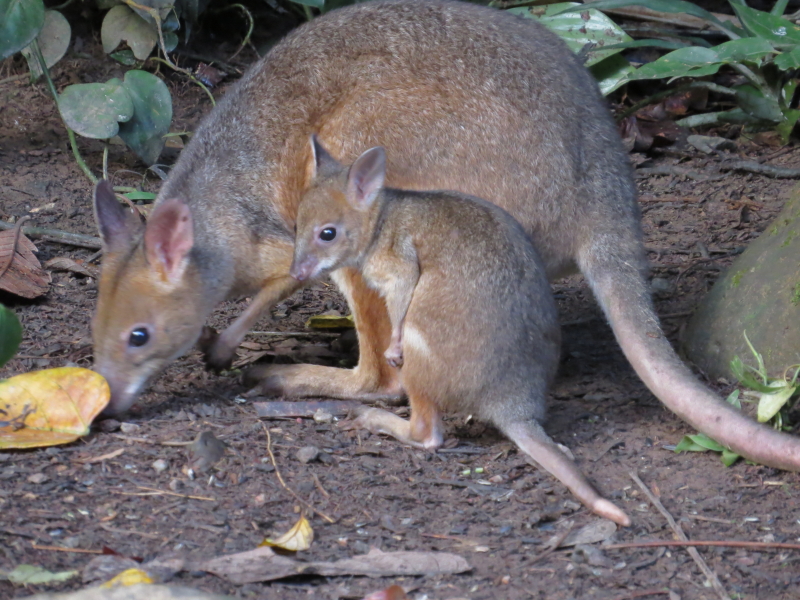
Here in Kuranda, this latest addition to our mob of Red-legged Pademelons has left its mother’s pouch for the first time (and the dominant male, quite possibly its dad, was there for the occasion, too).
baby-pademelon
img_4500_1
The little Red-legged Pademelon is hardly bigger than our smallest kangaroos, the Musky Rat-kangaroo.
        https://youtu.be/iWojTdpKR-g
 Most of the Musky Rat-kangaroo females have full pouches at this time of the year.
full-load_1
heavy-load
They normally have twins, and as you can see, it is getting crowded in the pouch.  I managed to get a few glimpses of babies shortly before mum left them behind in the nest, which she built from leaves on the ground in the forest.
fist-fights-in-the-pouch_1
whats-that-in-the-pouch_1

Cassowary update:

Dad and Socks are still mating (4 months now!), and leaving skid marks on the lawn:
mating-skid-marks
A few days ago, she made inviting moves towards him, he took the next opportunity to sit down behind a big rock , as if he wanted to hide from her. She certainly looked perplexed to me as she stood there on the lawn, waiting, for about 5 minutes! No mating  this time.
where-did-he-go_1

Cassowaries mating, July 2016

Today Dad spent half an hour feeding, preening and relaxing in our garden.

When he started to make himself really tall and strutted towards the cabin, I knew that Socks, his new mate for the last three weeks, must be within sight.

As you can see, he is not afraid of her anymore! Indeed, the first of their matings happened the day after I wrote the last blog.

She sat on the ground afterwards for a while, looking slightly dishevelled:

IMG_3692_1

This close-up (doesn’t she have great “eye-brows”!), shows what looks like a new tip of her beak:

sock's beak_1

From a greater distance (she’s on the left), her beak looks perfectly normal:

IMG_3701_1