The (almost) invisible python

Loud scolding by several species of small birds late in the morning brought a 2 meter long Amethystine python (Morelia amethistina) to our attention.
It was making its way up along the frond of a large tree fern, and when it had reached the crown of the fern, it began to coil itself into ever tighter loops until it almost appeared to tie itself into knots! A short while later it had all but disappeared from sight.

amethyst python 1

( Can you see it? Just to the right of centre):

amethyst python 3_1

Soaking up the sunshine in its elevated position, it stayed there all day, but in the early evening started to travel down a fern frond, through a fig tree towards our bird feeder, which also attracts small native rainforest rodents during the night -the python probably detected their smell.

amethyst python 4.0_1

The following photo gives you an idea of the beautiful iridescent coloration of the Amethystine Python:

amethyst python 4_1

In this picture, you can see the heat-sensitive pits  along the lower lip, which is typical for pythons:

amethyst python 6

Yesterday  a rare visitor arrived: a juvenile Satin Bowerbird (Ptilinorhynchus violaceus). It spent all day opposite our front veranda, nibbling fruit. This is our first sighting of this species in Kuranda; Satin Bowerbirds usually occur above 600 meters in north Queensland.

Satin Bowerbird

The fruiting Pandanus  and palm trees, of which we have many, are attracting several Spotted Catbirds (Ailuroedus melanotis) and Victoria’s Riflebirds (Ptiloris victoriae). At present we can watch three brown (female or juvenile) and one adult black riflebird in our garden every day.

Victoria's Riflebird

A few weeks ago  the first of probably many (last year we had a flock of over 50) Chestnut-breasted Mannikins (Lonchura castaneothorax) arrived; they were joined yesterday by another pair with very demanding and vocal offspring in tow.

A rather enervating youngster, a juvenile Sulphur-crested Cockatoo (Cacatua galerita) is keeping its parents busy regurgitating food with a constant, demanding wail.

Sulphur-crested Cockatoo


CASSOWARY UPDATE:

Human activities and the survival of cassowaries are almost always mutually exclusive:

Unfortunately, last week the resident female was killed by a vehicle on Black Mountain Road . As Dad has not made an appearance over the last two weeks, our hope is  that he is currently sitting on her eggs, at least partly keeping her genes in the pool (they had been mating for the last few weeks). She had only replaced Dad’s partner of many years, “Missy”, last year, and was in the prime of her life. Missy is still in the area and will, hopefully, mate with Dad again.

“Wattle”, also known as “Harriet”, was easily recognized by her unusual wattles:

Wattle

Intriguing Insects

The wet season is finally over, it went out with a bang (cyclone Ita) this time. Insects are around throughout the year, but summer is the best season to find them, they are more active and numerous.
Mayuko , a very keen and knowledgeable 12-year-old visitor from Tokyo , could teach us a thing or three about finding and observing stick insects and other more minute critters.

IMG_6574,trimmed_1


IMG_6701_1
Occasionally, we set up a mercury light and a white sheet in the evening to attract flying insects. You never know which fly-by-nighter might be lured down from the sky.
One evening we had 3 Hercules Moths (Coscinocera hercules), one of the world’s largest moth, and several Rhinoceros beetles (Xylotrupes ulysses), as well as almost 30 species of other moths and beetles, katydids and cicadas.

Hercules Moths are members of the Saturnidae family, females have the largest wing area of any moth in the world and a wing span of about 27 cm, the males have very elongated hind wings. They do not feed as adults (their caterpillars, of course, have a voracious appetite and grow to 12 cm long), and only live for a few days.

To give you an idea of their size: this male landed on one of our 16 inch 4WD tyres:

IMG_3367_1

female on left, male on right (both alive, by the way, not pinned or pegged to the sheet!):

IMG_3424,trimmed_1

A close-up of a male’s antennae:

IMG_3420,trimmed_1
Rhinoceros Beetles belong to the scarab family (Scarabaeidae), males sport  2  large, slightly forked horns, which they use to wrestle with other males. They grow to about 60 mm long, and, supposedly, are able to lift 850 times their own weight (they weigh about 85 g). They make a surprisingly loud hissing noise (by rubbing their abdomen against the ends of the wing covers), when one tries to pick them up – quite an effective deterrent , if you do not expect it.

Rhino Beetle


More interesting facts about them can be found here: www .qm.qld.gov.au/Learning…/~/…/fact-sheet-rhinocerosbeetles.pdf

Kuranda is an entomologist’s paradise, and we have quite a number of experts living here.

Dr. David Rentz has a blog with very detailed information and great macro-photography about all sorts of insects:

www.bunyipco.blogspot.com.au

Alan Henderson is breeding various critters, and his website is also worth a visit for insights into the lives of mini-beasts:

www.minibeastwildlife.com.au

Pygmy- possums

We found our first Pygmy-possum while spotlighting last week. There are 5 species of those very small (about 10cm head-body length) possums in Australia. Here in the tropical rainforest of North Queensland we have the Long-tailed Pygmy-possum ( Cercartetus caudatus). They are quite common in their restricted habitat, but not often seen, due to their minute size and arboreal habits.
The superficially similar Tree Mouse (Pogonomys sp.), a rodent,  also lives here, but they are very flighty, when discovered, and we have not been able to get a good photo of one, yet.
This Pygmy-possum is probably a juvenile, there is only a hint of its dark eye-patches and it was about 7cm long from head to base of tail. When it saw us, it tried to hide by sticking its head into the fold of a Pandanus leaf, but  peered at us with its big eyes after a short while:

Pygmy-possum 2

Pygmy-possum

Sunbirds

Sunbirds (Nectarinia jugularis) are similar to honey-eaters, but belong to a different family: the Nectariniidae.

male sunbird:

sunbird malefemale sunbird:

sunbird female
They are easily observed in north Queensland, often calling suburban gardens their home, and attaching their pendulous nests to verandah ceilings.
They readily accept a piece of rope , hanging from a timber beam, as the starting point for a new nest.

sunbird nestThe nest has a side entrance, with a hood over it and a tail under the nest chamber .
Our resident pair started building (usually he watches, while she constructs the nest) in October, and are now, after some mishaps, into their fourth round of breeding. The female sits on the clutch of 1-3 eggs for 15 days, then both parents feed the chicks for another 15 days in the nest.

sunbird female on eggsmore! more! MORE!:

hungry_1

sunbird female feeding chicks

house cleaning:

house cleaning_1
The most recent fledgling was still begging, while clumsily following its parents around the garden, when the adults started breeding again!

young sunbird:

baby sunbird
This time, the female decided to use the old nest again, saving herself a few days of construction work. She only reinforced the roof over the entrance, and added some extra lining to the nesting chamber.
The black butcherbirds (Cracticus quoyi) are also having offspring, and they often prey on sunbirds. The sunbirds’ behaviour of calling loudly near the nest before returning to it, does not seem to be very smart, as it might attract the butcherbirds.
This young butcherbird is slowly changing from brown into its black, adult plumage:

black butcherbird juvenile

acrobatic sunbird:

acrobatic sunbird

CASSOWARY UPDATE:

After 55 days of presumably sitting on eggs, dad returned to our garden without offspring. Quite possibly the wild pigs got to the eggs just before they were due to hatch!

Sadly this  is our first season without cassowary chicks .

On a positive note:

The Noisy Pittas (Pitta versicolor) are living up to their name, and seem to be all over the forest. So are the chowchillas (Orthonyx spaldingii).

The Red-necked Crakes (Rallina tricolor) are very active, with 3 chicks in tow.

The Buff-breasted Paradise Kingfishers (Tanysiptera sylvia) inspected and test-drilled some of our termite mounds, but decided to breed across the creek from us.

A  Lesser Sooty Owl (Tyto multipunctata) seems to have taken up residence here, calling most evenings and again early in the morning.

And now something completely different: a short excursion to the northern Northern Territory

It was HOT, considerably warmer than to be expected at this time of the year; in Kakadu National Park, Pine Creek and Katherine, temperatures reached 39 degrees Celsius every day, overnight temperatures did not fall below 25 degrees. Although bird/wildife watching hours were thus limited, we saw many interesting animals.

Northern Rosella (Platycercus venustus):
northern rosella

male Crimson Finch (Neochmia phaeton):

crimson finch

Fogg Dam and the nearby  rainforest were particularly  rewarding, with many different waterbirds, honey-eaters, flycatchers and raptors along the dam wall and several rainbow pittas in the adjoining monsoon forest.

Forest Kingfisher (Todiramphus macleayii):

forest kingfisher
forest kingfisher

Letter-winged Kite (Elanus scriptus):letter-winged kite

female Broad-billed Flycatcher (Myiagra ruficollis):

broad-billed flycatcher

Rainbow Pitta (Pitta iris):

rainbow pitta
rainbow pitta

Birdlife around Kakadu National Park’s wetlands was reliably abundant.

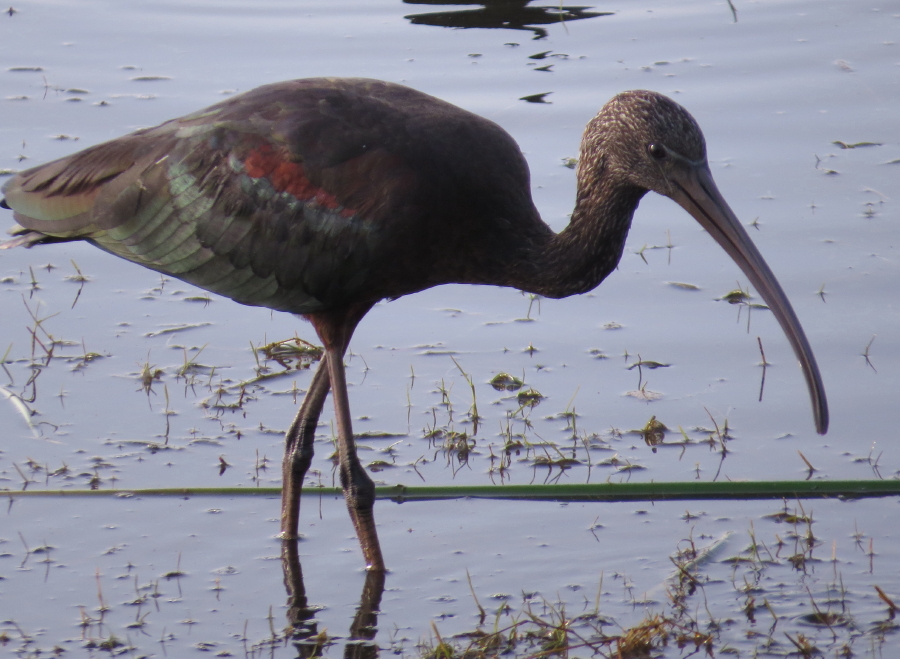
Glossy Ibis (Plegadis falcinellus):
glossy ibis

Comb-crested Jacana(Metopidius gallinacea):

comb-crested jacana

Long-tailed Finch (Poephila acuticauda):
long-tailed finch

on the lookout: Short-eared Rock Wallaby (Petrogale brachyotis):
short-eared rock wallaby

Chestnut-quilled Rock Pigeon (Petrophassa rufipennis):
chestnut-quilled rock pigeon

Banded Fruit-Dove (Ptilinopus cinctus):
banded fruit-dove
Kakadu’s  savannah woodlands, presumably under a regime of selective patchwork burning, looked severely charred and appeared to be burned indiscriminately everywhere and every year, with the exception of the areas around the major rock art sites. We would like to see evidence that this is beneficial to flora and fauna!

Yearly burnt:yearly burnt

Severely burnt:
severly burnt

Highlight of our trip was a close encounter with a jet-black male Black Wallaroo (Macropus bernardus), a shy, very muscular species of kangaroo endemic to the sandstone country of western Arnhem Land. Unfortunately, there is no photograph, we were trying to cool off in a creek, camera high and dry out of reach.

male Hooded Parrot (Psephotus dissimilis) at Pine Creek:hooded parrot, male

Black Kites (Milvus migrans) on a lamp-post in Katherine:
black kites on a lamp-post in Katherine

Cassowary update:

back home in Kuranda, our male cassowary and the new female are still together, “Missy” is visiting every now and then, and the juvenile seems to have disappeared.