Tree-kangaroos

Lumholtz’s Tree-kangaroos (Dendrolagus lumholtzi), one of the two Australian species (the other one, Bennett’s Tree-kangaroo, only occurs further north), are rare in the Kuranda area. Their stronghold are the Atherton Tablelands, and we are privileged to have them on our large forest property near Mount Hypipamee National Park, south of Atherton.
Lumholtz’s Tree-kangaroos, despite their size (like a small koala), are difficult to spot in the rainforest.

Tree-roo in distance

On our property, where the forest is more open, the resident male can sometimes be seen making his way along the creek -either on the ground or amongst the trees.

Tree-roo, climbing
Recently, we spotted him in a tree near our cabin while we were having lunch on the veranda.

Tree-roo, full view

Initially, when he noticed us, he was a bit nervous, as indicated by his tail-swishing, but he soon relaxed.


Tree-roo, close-up

After more than an hour he went on his way again.
Tree-kangaroos are not strictly nocturnal, they can often be observed during the day, too.

Sulphur-crested Cockatoos attacking Lace Monitor

This morning, while watching Musky Rat-Kangaroos in our garden, we heard Sulphur-crested Cockatoos (Cacatua galerita) screeching quite differently from their normal calls.

Musky Rat-Kangaroo

We discovered a group of 5 birds in the large Kuranda Quandong tree behind our house, harassing a Lace Monitor (Varanus varius), who had been minding her/his business, only trying to warm up in the early morning sun.

Cockatoo and Goanna

The cockatoos were quite brazen, getting very close to the lizard, even pulling on its tail, which the poor lizard then curled up in front of it.

Goanna

The cockatoos started snipping off twigs and branches close by, fortunately the goanna was sitting on a very sturdy branch. It didn’t show any aggression towards the annoying cockatoos, unless it was provoked. The reaction then was an inflated throat and a gaping mouth.

After about half an hour, the cockatoos flew away, and the lizard could finally relax.

Goanna at peace

As you can see, the tail with its long, narrow tip is unscathed, but you often see lizards with the tip missing. Brush turkeys also relentlessly attack them when they are on the ground, often biting into their tails. They have reason to scare off the lizards: goannas often raid nests and the Brush turkeys’ breeding mounds.

Green Ringtail Possum keeping cool

We had some good rainfalls two weeks ago, but the recent cyclones didn’t affect us at all- we had sunny and very hot conditions again.

Sitting on our back veranda yesterday afternoon, I noticed a big lump high up in a tree, about 20 metres away. My binoculars revealed this Green Ringtail Possum (Pseudochirulus archeri):


Green Ringtail Possum

Green Ringtail Possums spend the day curled up on a tree instead of in a tree-hollow, their greenish fur provides good camouflage.

This one was sitting on a very exposed branch, probably to catch the cooling breeze.

She repeatedly licked the bare underside of her tail and her hands/wrists, which might also help with cooling. It really was a very hot afternoon.

IMG_8486.2

How do I know it was a female? For a brief period she turned and showed me her belly:

IMG_8507.2

She has an admirable sense of balance: most of the time she only gripped her seat with the right foot, letting the left one dangle and using both hands to manipulate the tail.

I spent more than two hours watching this beautiful possum -it is so much easier from my deckchair during the day than trying to find and watch possums while spotlighting at night! She finally left when a thunderstorm approached.

Excuse the shaky last seconds, I was trying to get a photo before she disappeared.


Wet Season February 2015

With the recent advent of rain we have seen an abundance of insects (many stick insects !).

As big as my hand, this Hawk Moth (Coequosa australasiae), came to our light-sheet on a very rainy evening:

Hawk moth


Another visitor was this Stag Beetle:

Mueller's Stag Beetle2015

Spotlighting in our rainforest, we came across a pair of sleeping dragonflies:

Sleeping Dragonflies


and a group of sleeping male native bees (Mellitidia tomentifera):

sleeping bees_1

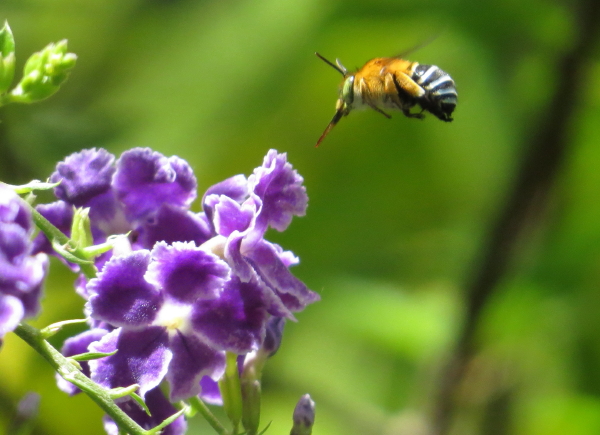
This Blue-backed Bee is one of many, collecting pollen in our garden:

Blue-backed Bee,Feb2015_1


If you are interested in native bees, you’ll find many photos and descriptions under the native bee project at www.bowerbird.org.

Another interesting insect is the Stalk-eyed Fly: The males have their eyes arranged like hammerhead sharks:

stalk-eyed flies

A piece of banana served as battleground: