Sunbirds

Sunbirds (Nectarinia jugularis) are similar to honey-eaters, but belong to a different family: the Nectariniidae.

male sunbird:

sunbird malefemale sunbird:

sunbird female
They are easily observed in north Queensland, often calling suburban gardens their home, and attaching their pendulous nests to verandah ceilings.
They readily accept a piece of rope , hanging from a timber beam, as the starting point for a new nest.

sunbird nestThe nest has a side entrance, with a hood over it and a tail under the nest chamber .
Our resident pair started building (usually he watches, while she constructs the nest) in October, and are now, after some mishaps, into their fourth round of breeding. The female sits on the clutch of 1-3 eggs for 15 days, then both parents feed the chicks for another 15 days in the nest.

sunbird female on eggsmore! more! MORE!:

hungry_1

sunbird female feeding chicks

house cleaning:

house cleaning_1
The most recent fledgling was still begging, while clumsily following its parents around the garden, when the adults started breeding again!

young sunbird:

baby sunbird
This time, the female decided to use the old nest again, saving herself a few days of construction work. She only reinforced the roof over the entrance, and added some extra lining to the nesting chamber.
The black butcherbirds (Cracticus quoyi) are also having offspring, and they often prey on sunbirds. The sunbirds’ behaviour of calling loudly near the nest before returning to it, does not seem to be very smart, as it might attract the butcherbirds.
This young butcherbird is slowly changing from brown into its black, adult plumage:

black butcherbird juvenile

acrobatic sunbird:

acrobatic sunbird

CASSOWARY UPDATE:

After 55 days of presumably sitting on eggs, dad returned to our garden without offspring. Quite possibly the wild pigs got to the eggs just before they were due to hatch!

Sadly this  is our first season without cassowary chicks .

On a positive note:

The Noisy Pittas (Pitta versicolor) are living up to their name, and seem to be all over the forest. So are the chowchillas (Orthonyx spaldingii).

The Red-necked Crakes (Rallina tricolor) are very active, with 3 chicks in tow.

The Buff-breasted Paradise Kingfishers (Tanysiptera sylvia) inspected and test-drilled some of our termite mounds, but decided to breed across the creek from us.

A  Lesser Sooty Owl (Tyto multipunctata) seems to have taken up residence here, calling most evenings and again early in the morning.

And now something completely different: a short excursion to the northern Northern Territory

It was HOT, considerably warmer than to be expected at this time of the year; in Kakadu National Park, Pine Creek and Katherine, temperatures reached 39 degrees Celsius every day, overnight temperatures did not fall below 25 degrees. Although bird/wildife watching hours were thus limited, we saw many interesting animals.

Northern Rosella (Platycercus venustus):
northern rosella

male Crimson Finch (Neochmia phaeton):

crimson finch

Fogg Dam and the nearby  rainforest were particularly  rewarding, with many different waterbirds, honey-eaters, flycatchers and raptors along the dam wall and several rainbow pittas in the adjoining monsoon forest.

Forest Kingfisher (Todiramphus macleayii):

forest kingfisher
forest kingfisher

Letter-winged Kite (Elanus scriptus):letter-winged kite

female Broad-billed Flycatcher (Myiagra ruficollis):

broad-billed flycatcher

Rainbow Pitta (Pitta iris):

rainbow pitta
rainbow pitta

Birdlife around Kakadu National Park’s wetlands was reliably abundant.

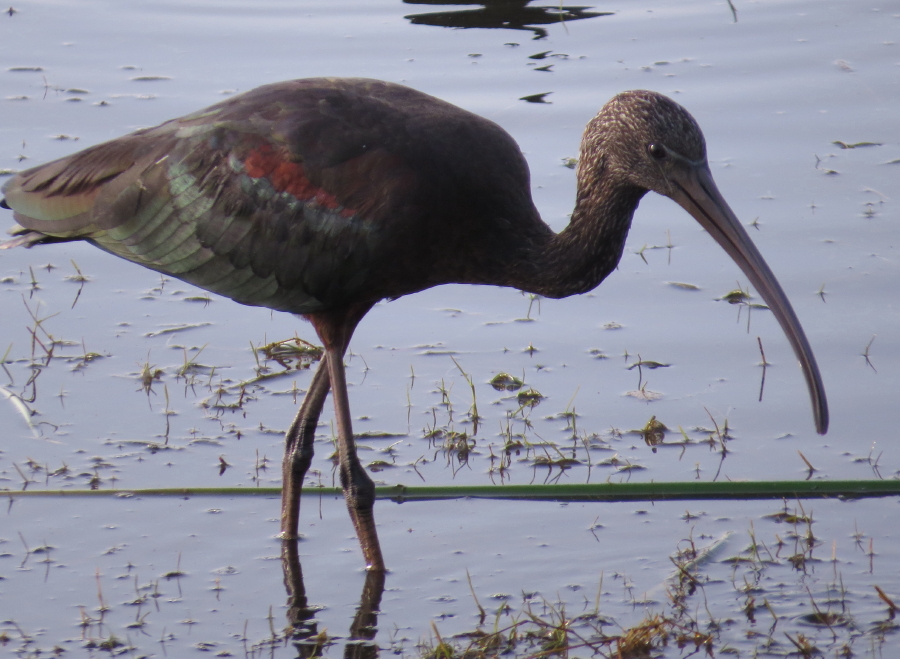
Glossy Ibis (Plegadis falcinellus):
glossy ibis

Comb-crested Jacana(Metopidius gallinacea):

comb-crested jacana

Long-tailed Finch (Poephila acuticauda):
long-tailed finch

on the lookout: Short-eared Rock Wallaby (Petrogale brachyotis):
short-eared rock wallaby

Chestnut-quilled Rock Pigeon (Petrophassa rufipennis):
chestnut-quilled rock pigeon

Banded Fruit-Dove (Ptilinopus cinctus):
banded fruit-dove
Kakadu’s  savannah woodlands, presumably under a regime of selective patchwork burning, looked severely charred and appeared to be burned indiscriminately everywhere and every year, with the exception of the areas around the major rock art sites. We would like to see evidence that this is beneficial to flora and fauna!

Yearly burnt:yearly burnt

Severely burnt:
severly burnt

Highlight of our trip was a close encounter with a jet-black male Black Wallaroo (Macropus bernardus), a shy, very muscular species of kangaroo endemic to the sandstone country of western Arnhem Land. Unfortunately, there is no photograph, we were trying to cool off in a creek, camera high and dry out of reach.

male Hooded Parrot (Psephotus dissimilis) at Pine Creek:hooded parrot, male

Black Kites (Milvus migrans) on a lamp-post in Katherine:
black kites on a lamp-post in Katherine

Cassowary update:

back home in Kuranda, our male cassowary and the new female are still together, “Missy” is visiting every now and then, and the juvenile seems to have disappeared.

Fig-Parrot Delight

One of the 3 Australian subspecies of double-eyed fig-parrots (Cyclopsitta diophtalma, ssp. maclayana) is quite common in our region, but often difficult to observe.
Mostly, you see them flying fast above the rainforest canopy, often giving a sharp, high-pitched call.
They sometimes feed in the trees on our property, and you can hear their soft contact calls.
Occasionally, they inspect tree hollows in larger, dead tree-tops and branches for potential nesting sites, sometimes enlarging the cavity by chewing into the wood.

female fig-parrot, excavating:

female fig-parrot, excavating nest

Kuranda’s village centre has many large fig trees, a lot of them the small-fruited Ficus benjamina.
Most of them are fruiting now, and I had the opportunity to observe a flock of more than 20 fig-parrots feeding there. Sometimes they even scurried to the lowest branches, only 2-3 metres above the ground, munching figs, completely oblivious to any observers.
It is a delightful experience to be able to watch these tiny, endearing parrots at such close range!

Can you spot the 2 parrots?:

fig-parrots in Kuranda,August2013

male double-eyed fig-parrot:
male double-eyed fig-parrot

female double-eyed fig-parrot:

female double-eyed fig-parrot

Cassowary Surprise

After mating throughout June our male cassowary (“dad”) disappeared, presumably sitting on a new clutch of eggs, while the local female continued to visit our garden infrequently.

She was here a few days ago, and after eating some palm fruits and lilly-pillies, made a deep, booming call. Shortly after that, there were two adult cassowaries drinking from our pond – dad was back!

Apparently he had been off his nest for a few days, abandoning it – maybe driven away by the pigs, which have been around recently.

Something looked strange about the female, and then we realized she was a stranger! She is at least as tall as “Missy”, our resident female, but with a taller casque and dark blotches on her two red wattles, one of which has two tips.

She might be the one who had a fight with Missy near “Cassowary House” recently.

Presently we are seeing dad always in the company of the new female, while Missy has been busy chasing the 10-month-old juvenile, which is, surprisingly, still visiting the area.

There does not seem to be a lot of ripe fruit available in the forest at the moment, but cassowaries also eat fungi and animals like worms, grasshoppers, mice and lizards.

Hopefully, dad will be able to put on enough weight to sustain him through another period of brooding. Male cassowaries sit on eggs for about 2 months without feeding.

dad and new female:

dad and new female,August2013

new female:

new female,August 2013_1

new female,August2013

juvenile cassowary:

juvenile cassowary July 2013

The September issue of the “National Geographic” magazine has an article on our ‘Big Birds’, with more photos of  Dad, Missy, and last season’s chicks.

Cassowary Mating Season 2013

How wonderful to be living in a place, where  cassowaries do not only visit our garden almost daily for most of the year, but where one can even observe them mating (also see our blog from May 2012).

cassowary dad 14.06.2013

This year the local male cassowary raised three chicks, which were  7 months old when the female started to seek out his company at the beginning of May. Initially, he wasn’t interested in her advances, but by mid May the family had separated. We now have  a single juvenile, and the other two travelling together, visiting. The adults started courting and mating in early June. This morning they performed in our garden, unperturbed by the noisy truck on Black Mountain Road (our local council is presently repairing the road, and we do fear for the cassowaries, who are frequently crossing. The juveniles are not as wary of traffic as the adults).

Sometimes we can tell that cassowary mating has taken place, without having actually witnessed it. Have a look at theses skid marks:

cassowary mating tracks

Minutes after this morning’s mating, the adults had just disappeared into the forest (we could still hear one of them booming several times in the distance), the single juvenile showed up for its breakfast of palm fruits.  Several of our palm trees are providing a feast for wompoo  and superb fruit-doves, catbirds, spectacled flying- foxes, white-tailed rats and cassowaries.

cassowary juvenile June 2013