Butterflies May 2013

North Queensland is particularly rich in butterflies, with more than 270 of Australia’s 420 described species occurring here. The Wet Tropics rainforests are the best places to find butterflies, and many species complete several generations per year, so most can be found throughout the year, but many adults are most abundant at the end of the wet season.

The largest species is the Cairns Birdwing (Ornithoptera euphorion), with the females reaching a wingspan of 125mm.
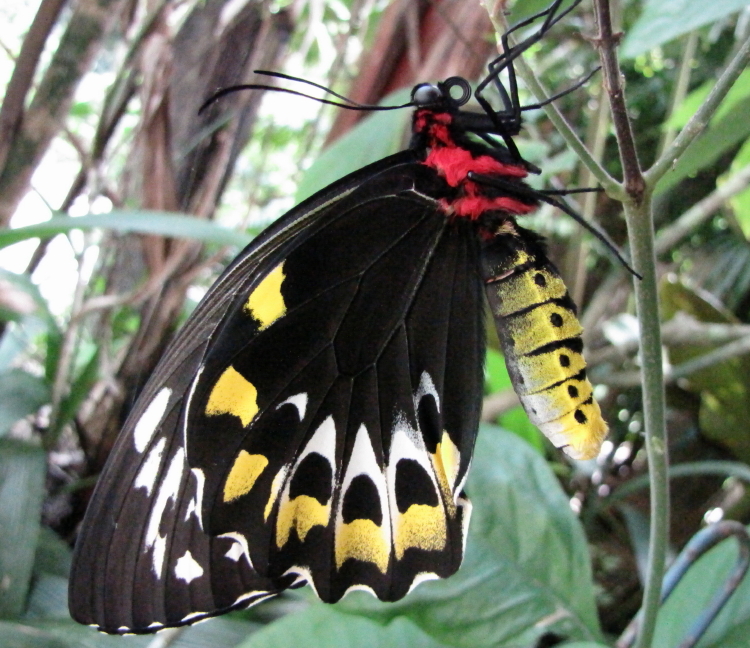
birdwing butterfly female

birdwing caterpillar and pupa

They are laying their eggs on a very small number of Aristolochia and Parastolochia species, of which we have many specimen in our garden and forest. Often, a male can be seen following a female:

The caterpillars incorporate the plant toxins in their bodies, and the adult butterfly is distasteful to predators, too, which allows them to sail leisurely through the air, whereas the Ulysses butterfly (Papilio ulysses) has a fast, erratic flight and always closes its wings when resting, exposing only the cryptically patterned underside.

ulysses 2

I was very lucky to observe this one, which must have just emerged from its pupa: it sat for several minutes with outstretched wings, and when it flew off, it fluttered rather clumsily low to the ground.

ulysses

A short time later, she was discovered by a male!

Blue Triangle (Graphium sarpedon) and Green-spotted Triangle (G.agamemnon) rarely stop to settle, flying powerfully and erratically.

Blue triangle

Another common, larger butterfly is the Cruiser (Vindula arsinoe). Males establish a territory by perching high on a leaf in bright sunlight,

Cruiser

the same behaviour is shown by the male Varied Eggfly (Hypolimnas bolina):

Varied Eggfly

The Large Green-banded Blue (Danis danis), a smaller species, prefers the darker, shady areas of the forest.

large green-banded blue

The aptly named Orchid Flash (Hypolycaena danis) can often be seen  around our Dendrobium and Cattleya orchids. The caterpillars are short  and chubby and have  exactly the bright green colour of the leaves, so are very hard to spot. Usually, I only discover them when the damage to the plant becomes obvious.

orchid flash

This pretty flutterer is not a butterfly at all, but a day-flying moth, Milionia queenslandica

Milionia queenslandica

Since we do not want to harm all those beautiful butterflies by catching them with a net, identification is a slow process,  but we will not run out of new species to add to our list for a long time.

For more details on the biology of the Birdwing butterfly, see the Wet Tropics Management Authority’s factsheet:

www.wettropics.gov.au/site/user-assets/docs/birdwingbutterflies.pdf

New Year’s eve in the Wet Tropics, January 2013

We’ve had hardly any rain for the last 5 months and the frogs’  sex drive seem to have reached monsoonal levels, the weather pattern has not. Many frogs have started to call from their hiding places during the day (mainly Litoria caerulea, common green tree frogs and Litoria infrafrenata, white-lipped tree frogs, but also Litoria rothii, northern laughing tree frogs and Litoria jungguy, northern stony creek frog) for the last few weeks.

Michel, who visited from Switzerland a year ago, was surprised that Australian frogs are only active at night, not like the European frogs. (I think, here they avoid the harsh sunlight).

Yesterday, we finally got more than a drizzle, about 16mm over 20 hours, and we had a very different New Year’s evening party in our garden and forest:

The male in the photo was already successful in attracting a female, but the other two nearby called through the night, usually well-synchronized, taking turns, sometimes calling more than 100 times before stopping for a recharge.

Later in the night they were joined by Dainty Green Tree Frogs (Litoria gracilenta), and in the morning we found a lot of spawn in our pond.The eggs of those 2 species look very similar, floating in small rafts on the surface.

Amongst the birdseed in our feeder, there was a different egg: this morning a chestnut-breasted mannikin (Lonchura castaneathorax) lost(?) one there. How/why does that happen?

Many bird species are feeding their fledglings at the moment,

Graceful Honeyeaters (Meliphaga graclis), Mistletoe Birds (Dicaeum hirundinaceum), Pale-yellow Robins (Tregellasia capito) and Wompoo Fruit-Doves (Ptilinopus magnificus) are just some of them.

pale-yellow robin

young pale-yellow robin

The young pademelon female (Thylogale stigmatica), presented in our “pademelon courtship” blog 5 months ago, now has a pouch young, which should soon be big enough to explore the world on its own feet.

red-legged pademelon 2

red-legged pademelon 1

Cassowary dad visits daily with his chicks, leaving droppings behind everywhere. They contain many seeds, e.g. Kuranda Quandong (Elaeocarpus bancroftii), Black Palm (Normanbya normanbyi) and Northern White Beech(Gmelina fasciculiflora).

Wishing you all a happy and fertile new year:

cassowary droppings 1

New Cassowary Chicks, December 2012

“Our” cassowary made an appearance, with his 3 two-month-old chicks, one week ago.
The chicks are inquisitive, yet still keep very close to dad.
They all look very healthy and well fed. Quite a few trees are fruiting; several species of figs and laurels, Black Palms (Normanbya normanbyi) and Kuranda Quandongs (Elaeocarpus bancroftii)- the latter two might still be a bit too  large for the chicks to swallow.
Unfortunately,”our” cassowary’s core territory , he had his nest there,  is under threat:
the 28 ha rainforest property between us and Kuranda National Park has been advertised for sale.
Without interest and support from governments we are trying to raise funds to purchase and conserve said property in perpetuity.cassowaries December 2012cassowaries December 2012.2cassowaries December 2012.3

new cassowary chicks

Geckos and other Lizards, October 2012

Digging a trench through the rainforest has its rewards: A northern leaf-tailed gecko (Saltuarius cornutus) fell out of the canopy close by, hotly pursued by a spotted catbird. The catbird was quite persistent in its effort to get to its prey, and human intervention was not what it had expected.

We wouldn’t have thought a catbird might be preying upon a gecko almost its own size.

This gecko’s tail is not the original one (it is smoother, not as spiky) : they can regrow a new tail after injury or deliberate discarding ( in order to distract a predator, while making a get-away – the discarded tail even wriggles around for a while).

Now that it is getting warmer, reptiles are more active. Our resident spotted tree monitor (Varanus scalaris) is clambering up and down its favourite post on the cabin every day, and we are encountering more snakes.

A female water dragon (Physignathus lesueurii) was observed laying eggs in a small sandy hill very close to a creek and  only about 1 metre above the waterline. The last 2 years we watched a water dragon digging her nest about 20 metres from the creek, and several metres higher. Could this mean that there won’t be any flooding rains in the foreseeable future? The eggs  take about 2 months to develop.

Finches and Termites, October 2012

After 12 weeks of mostly dry weather we finally had some welcome rain last night and today (25mm), which led to an interesting observation:

Red-browed finches (Neochmia  temporalis)  and chestnut-breasted mannikins (Lonchura castaneothorax) were hopping around in our driveway, picking up termite alates (winged termites), which had just swarmed from their mound, and even catching them in mid-air.

It was surprising to see such typical seed-eaters gorging themselves on insects – and performing some very acrobatic manoeuvres.

Maybe the female finches are stocking up on protein for the production of eggs.

We normally do not have finches on our rainforest property- the grassy areas are rather small. A few pairs of red-browed finches usually arrive in November to build nests, mainly in the palm trees, but then leave at the end of the wet season.

This year, two pairs decided to stay (possibly because we left a few patches of lawn to go to seed), and we put out some bird seed for them. This must have stopped a small flock of chestnut-breasted mannikins in their tracks (we never had them here before) – and they told their friends! We now have a flock of over 100 (they are really difficult to count, being very flighty).

red-browed  finch

one chestnut-breasted mannikin

many chestnut-breasted mannikins

CASSOWARY UPDATE

We are eagerly awaiting dad’s return after he disappeared  more than 2 months ago.

He never brooded the clutch of 8 eggs he had in early July and abandoned that nest.

Hopefully, the female produced another batch for him.

She is still visiting every 5 to 15 days, looking a bit worse for wear, having lost the rich gloss of her plumage and rather threadbare thighs ( the male scratches her thighs with his claws, when she is sitting down, and he tries to get into mating position). So, presumably, she has been mating with another male.