Cassowaries and Riflebirds

young Southern Cassowary, by Steve Bond

The cassowary mating season is in full swing and we can hear a lot of  booming in the forest. The large female, “Wattle” and her mate, “Goldfinger” have been seen together several times. Another 2 cassowaries have also turned up: “Dad” with one chick is visiting us almost daily, often they are enjoying this sunny spot between cabin and house:

Southern Cassowary male and chick, enjoying the winter sun

Dad is apprehensive in the presence of the female and takes off when she approaches. She doesn’t seem to be really aggressive towards him and is very nonchalant towards the chick. It could well be her own, as Dad and Wattle were together last June, when he came through with 2 chicks (who were about 3 months older than this year’s single survivor).

Yesterday, Dad tried another tactic to evade the female: he crouched down in the densest patch of shrubs, lying as low as possible. Of course, she knew he was there, especially with that chatty chick nearby, and slowly walked towards him. When she got within a few metres of his ‘hiding’place, he lost his nerve and ran.

“M”, the young male or female bird, has drawn the short straw, being chased vigorously by Wattle and very afraid of Dad. This beautiful image was taken by one of our guests, Steve Bond:

young Southern Cassowary, by Steve Bond


Our Victoria’s Riflebirds don’t seem to know that they are supposed to take a break from all that displaying business. The adult male and one immature male, who changed into adult plumage last summer, kept going throughout  the molting season and are displaying daily on the favourite post near the cabin whenever a female comes into view.

Here are a couple of Steve Bond’s images:

mature male Victoria's Riflebird, displaying, by Steve Bond

mature male Victoria's Riflebird, displaying, by Steve Bond

We haven’t noticed any offspring this year, so maybe the adverse conditions (a long, very dry 2018, with very little flowering/fruit-setting taking place) didn’t get the female riflebirds into mating and nesting mood.


A Tale of Two Cassowaries

Southern Cassowary

Last March a new juvenile cassowary appeared in our forest. Judging by the size of his casque and wattles and the fact that there were still some brown feathers visible on the back, we tentatively assumed it was a 3 year old male. He had unusually long, light-coloured “fingernails”: the quills sticking out from the rudimentary wings.

Distinguishing features of cassowaries are mainly the casque, which might be straight, leaning to one side or the other, big or small (although in a young bird it would most likely keep growing for a few years), and the wattles, which can be short, long, one longer than the other, or oddly shaped.

Southern Cassowary
Southern Cassowary

He came past our house and the cabin quite regularly, and when we noticed, that he didn’t have his long, golden quills anymore, but shorter, black ones, we assumed that he lost them while moulting.


Southern Cassowary
Mr March

To our surprise, he recently showed up with his quills as long and golden as before! Shortly thereafter, they were black and short again! TWO birds! Same size, very similar casques and wattles, but very different quills!

Southern Cassowary
Goldfinger
Southern Cassowary
Mr March
Southern Cassowary
Goldfinger
Southern Cassowary
Mr March

So, when trying to identify individual cassowaries, have a close look at their fingernail as well!

Moths

Queensland Day Moth, Alcides metaurus

Australia has 20-30000 species in the order Lepidoptera, of which about 450 are butterflies. There isn’t a big difference between butterflies and moths. Both usually have a coiled proboscis and four scaly wings. Some butterflies are active at night, and numerous moths  fly during the day,  many of those have clubbed antennae. One of our  more conspicuous species is the large Queensland Day Moth, Alcides metaurus (family Uraniidae):

Classifying moths is often not easy: one might have to look at their genitals, which are usually withdrawn into the abdomen! Therefore, some of the moths featured in our blog posts do not have a name to them (feel free to let us know, if you can identify them!), sometimes we cannot even  determine the family (there are about 80 families in Australia). Birds are so much easier!

A few nights ago, our mothlight attracted, amongst many Christmas and Rhinoceros beetles and other moths:

Aglasoma variegata (family Lasiocampidae):

viewed from another angle:

and a portrait, showing off the ‘woolly legs’:

Another species, holding the abdomen in an upright position, maybe for better camouflage:

Praesusica placerodes (family Limacodidae):

A front view reveals the striped legs:


and some more moths:

Hawk Moths (family Sphinghidae) are plentiful at the moment:

and so are the often very large Wood Moths (family Cossidae). The famous ‘witchetty grubs’ belong here.

The variety of patterns and shapes seems endless. These moths are well-adapted to life in eucalypt forests. You wouldn’t be able to spot them  amongst dried gum leaves:

or this moth on the bark of a Red Mahogany:

There surely will be more posts to come about moths, featuring our more unusual and/or colourful species!

A most beautifully presented, and very useful guide for identifying our local moths, is Buck Richardson’s book

Tropical Queensland Wildlife from dawn to dusk, Science and Art”.

Contact details for Buck are:

buckrichardson@leapfrogoz.com.au

www.leapfrogoz.com.au

Birdlife in December

adult male Victoria's Riflebird displaying

After some rain (cyclone Owen didn’t have much effect on us), many more birds are breeding now. There are more insects around for feeding their offspring. We also have a large number of honeyeaters taking advantage of the mass-flowering of Red Mahoganies.

The Victoria’s Riflebirds are still displaying, although they have started their yearly moult, and the males don’t look their best.riflebird moulting2_1

That additional row of emerging wing feathers looks quite attractive!riflebird moulting_1

Despite the lack of fruit at the moment, some Superb Fruit-doves have decided to nest here. We observed one nest (from a long distance!), where the chick fledged after only one week, which is normal for Superbs.IMG_3214.j2pg

In typical pigeon style, the nest is a very flimsy affair. No wonder, the chick doesn’t stay!IMG_3296

An unusual visitor to the cabin was a Varied Sitella. They normally occur in  drier forests (Springvale Road is more their habitat), and we’ve seen them once before in the Casuarinas in the western part of our forest.

Little Red Flying-foxes and Spectacled Flying-foxes

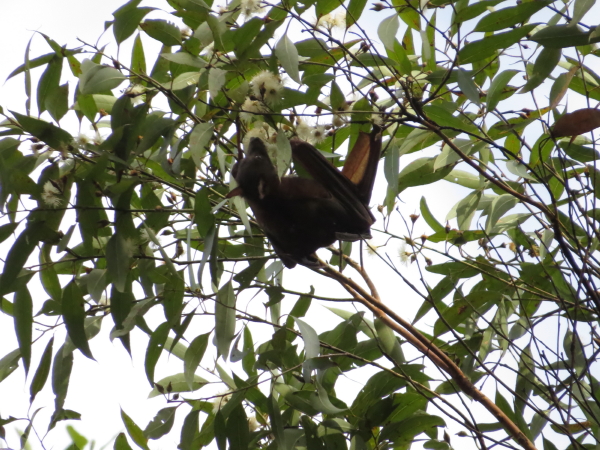
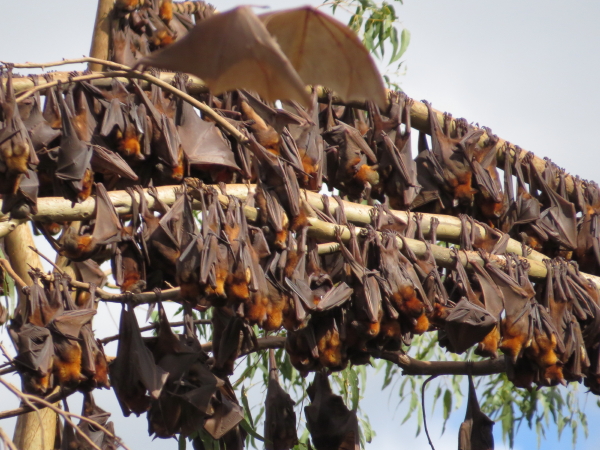
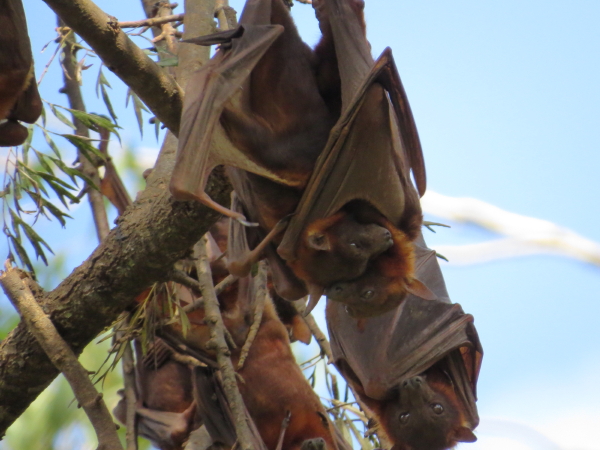
Little Red Flying-foxes

The Red Mahogany trees (Eucalyptus resinifera) in our area finally began to flower a couple of weeks ago, and, as expected, are attracting large numbers of Little Red Flying Foxes (Pteropus scapulatus).

They are easily distinguished from other large fruit bats: their wing-membranes are translucent in flight and they are considerably smaller than the other large flying- foxes. Brush-like tongues (like lorikeets) make collecting nectar and pollen very efficient.

They feed at night, although at the moment they are arriving in our forest as early as 3pm. We very much enjoy listening to them: they constantly call to each other with soft, fluting whistles, and, of course, also squabble noisily. In this video, the calls in the background are being made by Scaly-breasted and Rainbow Lorikeets.

During the day, Little Reds gather in campsites, which they occupy for as long as there are flowering trees nearby.

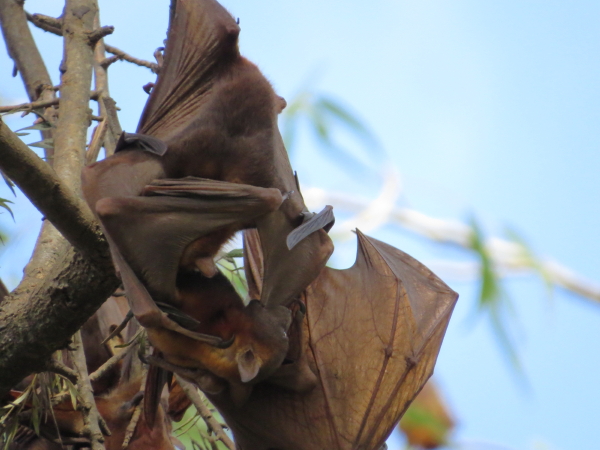
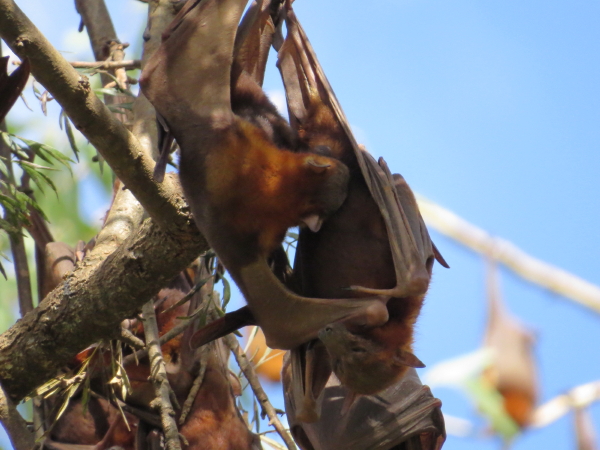
The summer months are mating season, so you can watch them courting, play-fighting, mating

and cuddling up:

Males are well-endowed, and, like other flying-foxes, anoint their neck ruffs with a smelly liquid from their penis, which they rub onto branches for scent-marking.

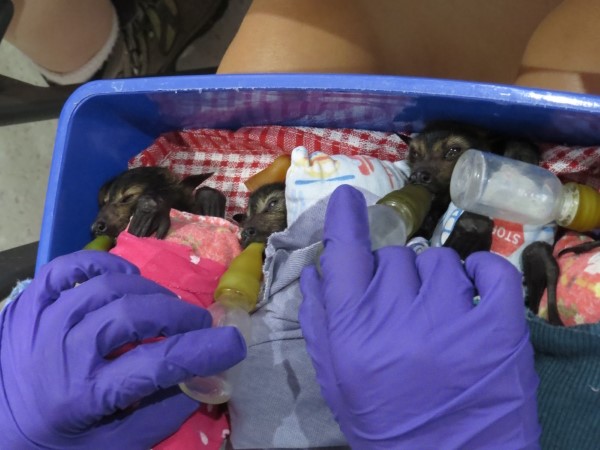
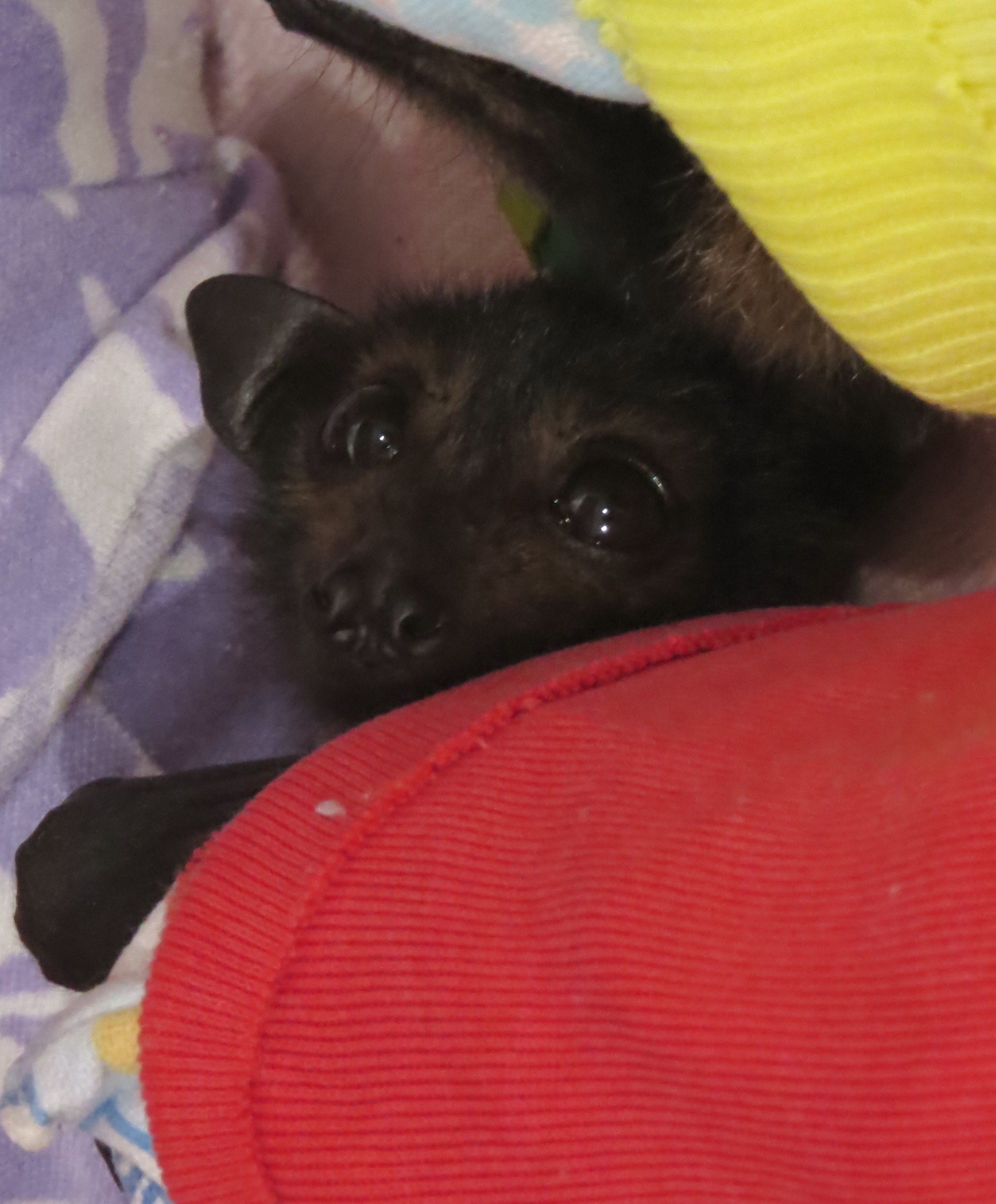
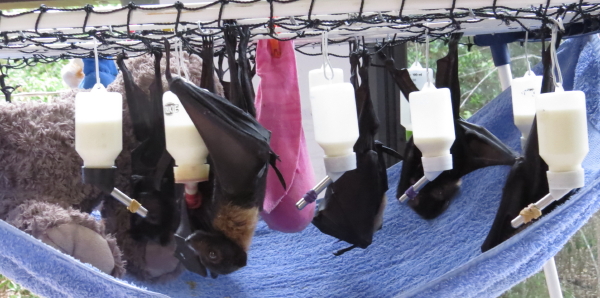
There was a severe heatwave in North Queensland in late November, which caused the death of thousands of the much rarer Spectacled Flying-foxes (Pteropus conspicillatus) along the coast (Little Reds are more heat-tolerant). It is  birthing season for the Spectacleds, and many babies were orphaned.

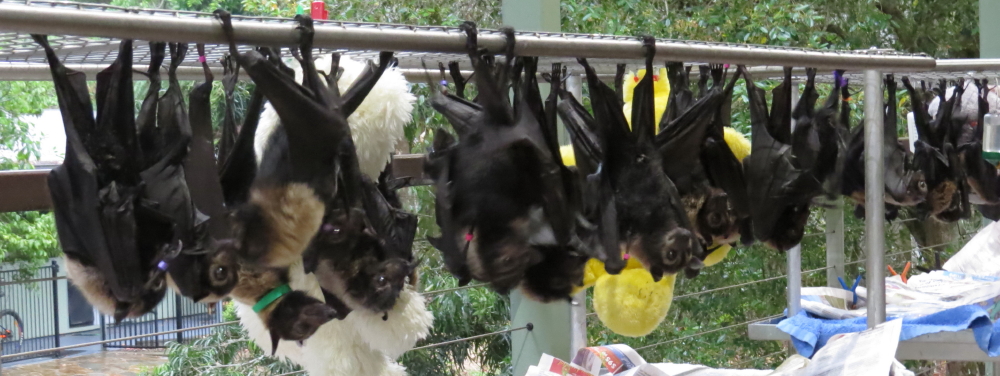
The Bat Hospital near Atherton has currently more than 500 bats in care, with volunteers working around the clock to look after them.

For more information, booking a guided tour, or donations:  www.tolgabathospital.org

Ex-tropical cyclone Owen just passed over our area, bringing wind and lots of rain. Interestingly, the Little Red Flying-foxes came in to feed very early (at 3pm) the day before yesterday, and not at all yesterday/last night. They may have known something…